
You must have heard the old maxim that goes something like, ‘What the critics say doesn’t matter’. That may have been true once, and it may still be true for those already well-known authors and big publishing houses. The author’s new book comes out, the fans go straight to on-line retailers like Amazon… click-click… no-one cares what any reviews say, the book is sold!
That’s all very well for an author with fans and followers. How does it play out for a new author trying to establish themselves in this wicked world? Publishing is easier nowadays, right? You can do it yourself! Unfortunately, publishing a book isn’t the same as selling it. Independent publishing is a bit like opening the world’s greatest boutique store in an encampment at the North Pole – you may feel warm inside but it’s an awful long way from civilisation and no one comes to shop at your store.
In this blog post, I’m going to try to explain why reviews have a big effect on the economics for the independent publisher. I don’t mean trying to get a review in the Sunday Times, I mean those review scores and written reviews that appear on your book page when someone clicks through to read the details of your book on an online retail site (Amazon, being the big one).
For this purpose, let me use a reference publication: my recently-published short story collection – Blight and Happiness. Here I am, happily holding copies on Publication Day:
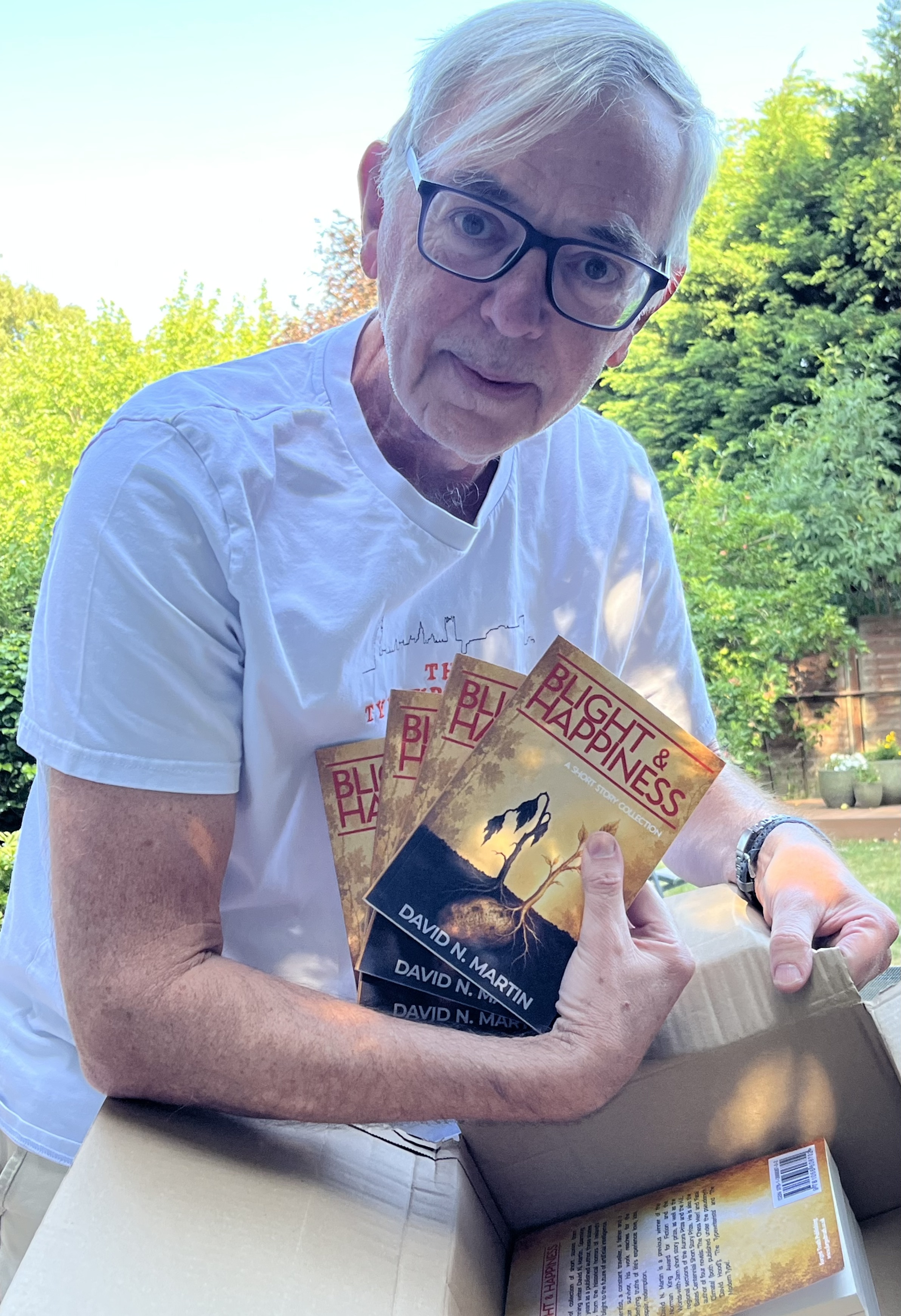
Now, before all this smiling-happy-sitting-in-the-garden-feeling-proud stuff happens, you will already have made decisions that have big consequences for your sales and marketing plan. (Bear with me, I’m getting to the importance of reviews in just a moment!)
First: you had to decide how to get the book printed and distributed? One way to do that would be to print a big batch of copies, keep them in the garage and sell them to people who want to buy them. Problems: an economically-sized batch of copies is a big investment, you need a big garage and, when people buy books, someone has to package them up and deliver them.
Long story short, I decided not to do that, mainly because Amazon has this helpful service called ‘Kindle Direct Publishing’. The name is confusing. KDP will let you publish paperbacks and hardbacks on demand, as well as distributing the Kindle version of your book. Great! Except that, when it comes to print copies, this is a print-on-demand service, so although you avoid all the big up-front printing costs, you don’t need a big garage, and – joy of joys – Amazon will print your book and ship it when your orders roll in, you’d better believe, it costs! The price per copy is significantly higher than printing in big batches. On the face of it, Amazon will allow you a whopping 70% royalty on sales, but you have to pay the cost of that one-at-a-time printing out of your royalties. Let’s suppose your book costs £3.50 to print, that means the first (3.50/0.70)= £5.00 of your selling price disappears before you see a penny of royalties.
With that cost reality in mind, now pick your selling price. Let’s say you choose £7.99. That gives you 70% of (£7.99-5.00) as a royalty on every sale. That is £2.09 per copy.
I’ve kept you waiting, but now we get to the ‘importance of reviews’ point. Assuming you want to make a profit, you now know you can only afford £2.09 per copy to advertise, market and otherwise promote your book.
Unless you have some experience as a celebrity, influencer or other prominent status, your quickest and most efficient way to market your book is to pay your way onto search results on a site like… well, like Amazon actually. The way the Amazon system works is simple, but has massive consequences for your commercial success (other sites do similar things, no doubt). Essentially, when someone in the world (a user who is a potential buyer) searches for say ‘Great Historical Books’, you can make sure you are high up the list by setting your marketing campaign to ‘bid’ a lot of money for every ‘click-through’ you get. A ‘click-through’ in this context means the user ‘clicks-through’ to the page that gives details of your book. It does NOT mean the click that buys the book. Typically, to get on the first page of a search against any popular search phrase, you will be bidding 30 to 50p per click-through. What’s important to understand here is that you are paying for a click-through, but there is no guarantee this gives you sales.
Let me explain that in a bit more detail. The way this marketing service plays out is simple: you bid higher than everybody else (let’s say, 50p per click-through) and your book will appear high in the user’s search results. OK, but you haven’t spent the 50p yet. It’s only when the user thinks they might like to look at the details of your book and clicks on the link that… Bam!… now you’ve then spent the money you bid.
Obviously then, what’s important to you is ‘Will this click-through lead you to sales?’ Well, maybe, but maybe not. Nothing is guaranteed.
Let’s imagine the user at this point. They are now looking at your details page, i.e. the description of your book and – most importantly – the reviews and the review score for your book. You have paid 50p to get them here. If they decide to buy, you make a net gain of (£2.09-0.50)= £1.59, but if they don’t decide to buy you’ve just lost your 50p. To make a profit, for every sale (profit £1.59), you can only afford three people to click through and not buy. This is alarming, right? You can only afford to market your book effectively if you make one sale for every four people who click through to your details page. Ouch!!!
Now, the numbers will differ a little for different books (because the prices and printing costs are in slightly different ratios), BUT the point is clear: what matters is what percentage of people who click through to your details page will buy your book. How can you influence people at this point? I submit that, within the info on your page, there are only four things you can play with to influence your potential buyer:
• The price
• The cover
• The description of the book that you write for yourself, and…
• The review scores and the review texts from previous buyers which tell your potential buyer whether your book might be remotely worth reading.
What am I trying to tell you here? It’s this: if you are self-publishing or publishing independently, get ready to beg your family, your friends and anyone you might happen to know to go onto as many on-line retail platforms as possible and write a review with lots of stars (Amazon being by far the biggest). Research proves that, when assessing writers they are unfamiliar with, the reviews are the biggest factor for your potential buyer and, as our little journey into harsh arithmetic above has proved, your publication will never make money if can’t get the sales to click-through ratio up to a surprisingly high number. It seems a somewhat backward statement, but you can’t afford a lot of people who click idly onto your book page and then don’t decide to buy. Your page has to do a lot of sales work, and reviews (the number, the eloquent prose of the reviewer and the star rating) really, really matter.
Good luck! It can be done, but it’s hard. From experience, if you can get 20+ good reviews, it starts to have a favourable effect on the ratio. 50+ is better. Driving sales this way, I have to say that the best I ever managed (for one month only) was a ratio of 5 click-throughs for every sale. It was more typically 10:1.
Contributed by David N. Martin, author of ‘Blight and Happiness‘
 leicesterwritersclub.com
Thank you Dave, this is a great blog. I’m paying a marketing expert to sell my two self-published books on Amazon and I now understand how it works and what I’m paying for. I am sure that without his input I would have made few sales but I am also sure that I essentially remain in debt from the act of self-publication but it has seemed worth it to get those two books ‘out there’ and read, especially my memoir ‘Almost Boys’.
Best Wishes, Morag
LikeLike
Thanks Morag
LikeLike